

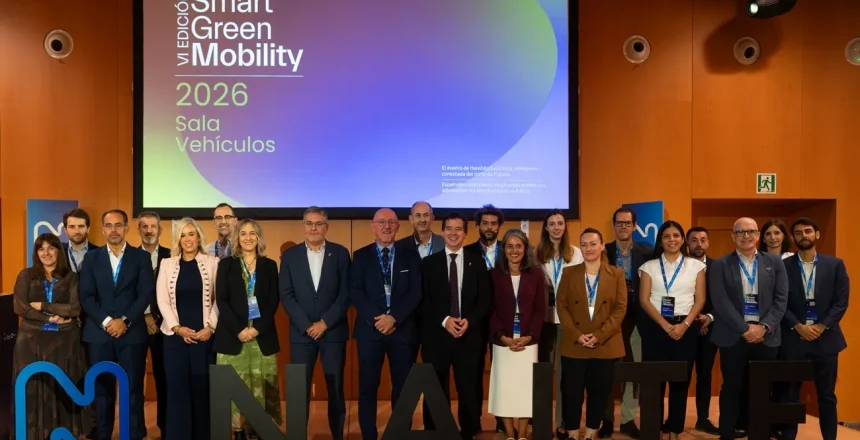
More than 200 professionals from industry, research and government gathered in Pamplona for the sixth Smart Green Mobility (SGM) forum. Organised by the technology centre NAITEC and the Government of Navarra, the forum examined how Chinese competition, tariffs, electrification and artificial intelligence are reshaping the mobility sector.
Held at the Baluarte Congress Centre and Auditorium of Navarra, the event highlighted the strategic weight of the automotive industry in Navarra’s economy. Navarra has the highest share of industrial GDP of any Spanish region. Around a quarter of that industrial wealth is linked to the automotive sector, which generates 45 of every 100 euros the region exports.
Collaboration to compete
Txus Pintor, Managing Director of NAITEC, opened the forum with a warning: “China is here; it is already in Europe.” He called for anticipating change and for an electrification strategy that keeps production, jobs and wealth in Europe. To achieve this, he urged closer collaboration between technology centres, universities and companies, particularly on production processes.
Juan Luis García, Regional Minister for Universities, Innovation and Digital Transformation, stressed that “no single organisation can drive a transformation of this scale on its own”. He also underlined the need to strengthen Navarra’s competitiveness, create quality jobs and advance the green and digital transitions.
A new global landscape
Sergio Caballero, of Nebrija University, described the current period as an “interregnum” of change. He warned that protectionist tariffs could backfire and accelerate electrification and the energy transition, and advised companies to focus on business diplomacy and sustainability.
According to Jorge Juárez, Corporate Director of Innovation and Marketing at Antolin, China is redefining competitiveness in the sector: on top of quality, cost and industrial capacity, it has added “the speed to learn, develop and reach the market”. He explained the company’s approach of developing in China for China and supporting Chinese manufacturers as they expand internationally. He also described collaboration with NAITEC as key support for Antolin and other suppliers.
Jaime Borrell, Business Development & Public Affairs Director at Alstom Spain and Portugal, explained that geopolitics and climate change are already shaping railway design. Alstom has hydrogen and battery trains in commercial service, and a team of more than 100 people working on AI, which is advancing fastest in maintenance and fault diagnosis.
Artificial intelligence: from promise to the factory floor
The roundtable “From the promise of Artificial Intelligence to industrial reality” brought together three speakers:
- Pedro Santesteban (Global Engineering, Antolin): with a reliable database, AI can complete in minutes simulation and design analyses that once took weeks.
- Ismael Arina (Head of Business Development, ZEO Technology): before applying AI, companies must digitise their information and define a specific problem, because “AI multiplies the value of having digitised”.
- Roberto Lanaspa (Chair of the Navarra Automotive Cluster, ACAN, and board member of KWD): responsibility for AI outcomes always rests with the company, and critical tasks should not be delegated to it.
Energy efficiency and sustainability
Sergio García, Energy Efficiency Engineer at Gestamp, noted that manufacturing accounts for 20–40% of an electric car’s lifecycle emissions, compared with 10–25% for a conventional vehicle. He outlined the company’s model, based on annual reduction targets for each plant, real-time monitoring and the roll-out of best practices across its 115 plants in 24 countries.
Representing the aerospace sector, Elisa Areso, Head of Manufacturing Engineering at Aciturri Aeroengines, described a dual challenge: reducing environmental impact in line with the EU’s 2050 climate-neutrality goal while remaining competitive on cost, quality and lead times. She presented the TITAN project, coordinated by the company since late 2023, which develops joining and surface-treatment processes that improve component properties and make remanufacturing easier.
Attracting investment and embedding it locally
Mikel Irujo, Regional Minister for Industry and for Green and Digital Business Transition of the Government of Navarra, closed the forum. In his view, the key question is not whether a car is electric, but who manufactures the vehicle, its batteries, its software and its components. He summarised the regional government’s strategy in two strands: attracting investment and ensuring it becomes embedded in Navarra’s industrial ecosystem. He added that the government has authorised renewable energy projects to meet electrification demand, and that the next challenge is to consume that energy within the region. He also called on Europe for regulation that protects domestic manufacturing and for faster administrative procedures: “If China sets the pace, Europe must step up.”
Source: Navarra Capital