




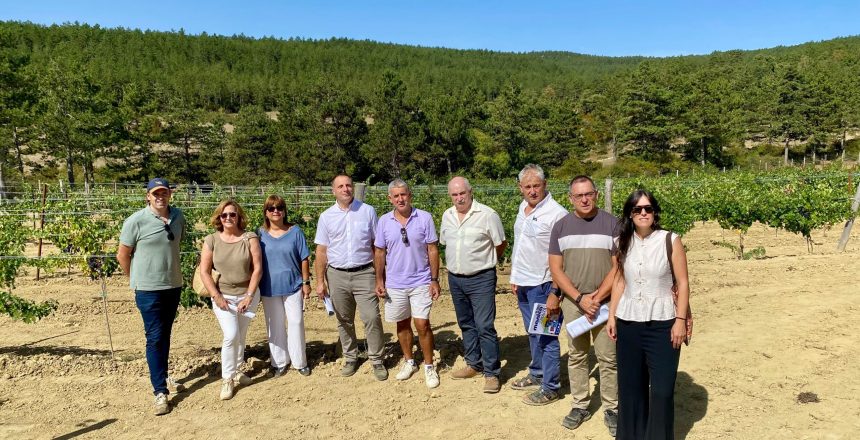
The Department of Rural Development and the Environment, through Navarra’s Viticulture and Oenology Station (EVENA), has launched an experimental trial at its Sabaiza estate (Ezprogui) to study how vines are adapting to climate change and identify the varieties and growing practices best able to withstand its effects.
A problem already showing up in the glass
Rising temperatures and longer drought periods are speeding up grape ripening, raising sugar content and lowering acidity — the result is wine that is more alcoholic, less fresh, and carries different aromatic profiles than traditional styles. The shift is a particular concern for an industry already going through a period of crisis, and whose strategy in Navarra is not to increase output but to improve quality and sharpen varietal differentiation.
José Mari Aierdi, Navarra’s Minister for Rural Development and the Environment, put it this way: “the effects of climate change are a reality that will inevitably intensify across every area, and viticultural research to adapt to these scenarios has become a first-order challenge for Navarra’s wine sector, where we clearly need to back innovation, differentiation, quality and the prestige of our brands to turn this crisis into an opportunity.”
A plot chosen for its strategic location
The vineyard covers roughly one hectare in Sabaiza, in the Merindad de Sangüesa/Zangoza, chosen for three reasons: its altitude of 820 metres — historically, few Navarra vineyards sit above 600 metres — nutrient-rich soil with good water-retention capacity, and geographic and climatic conditions well suited to the trial.
There, EVENA is studying the behaviour, adaptive capacity and resilience of 25 grape varieties — 15 red and 10 white — of varying origins, alongside three recovered native varieties: ‘oneca’, ‘musa’ and ‘berués’. In total, 28 varieties are under observation.
The whole industry on the ground
Minister Aierdi toured the plot alongside Rubén Goñi, Director General of Rural Development, and a broad group of wine professionals: researchers, wineries, growers and representatives of the DO Navarra Regulatory Board, the Navarra Wineries Association (ABN), the Viticultura Viva collective, farmers’ organisations, the public body INTIA, and the UPNA and University of Navarre.
Also invited were Sergi de Lamo and Jesús Yuste, Director General and Scientific Coordinator respectively of the Wine Technology Platform (PTV), Spain’s leading association for viticultural research and innovation. The presentation was led by Ana Sagüés and Félix Cibriáin of EVENA’s technical team, and the event closed with a tasting of Reyno Gourmet produce and of EVENA’s experimental oneca and berués wines, made by its winemaking team, Alfredo Rueda and Izaskun Oria.
Through cultivating, harvesting and monitoring the selected vines, the project aims to define a validation methodology for climate-adaptation trials that can be standardised and replicated across the wider production sector.
Why it matters
Wine is one of Navarra’s most climate-exposed agri-food sectors — and one of its most internationally recognisable. Having government, public research and the industry itself working together to get ahead of the problem, rather than improvising once the pressure hits, signals long-term management that reinforces Navarra’s credibility as an innovative, well-governed agri-food region.
Source: navarra.es