



- Navarra’s agri-food industry has established itself as one of the region’s main economic drivers, underpinned by an ecosystem that combines agricultural production, industrial capacity, innovation and a strong export orientation.
- The sector is entering a new phase of transformation, driven by nearly €200 million in investment aimed at expanding productive capacity, automating processes and launching new industrial projects.
- Navarra supports this growth through public policies designed to attract investment, promote food innovation and foster business development, strengthening the region’s appeal for new agro-industrial projects.
Navarra’s agri-food sector is entering a new phase of expansion, shaped by industrial investment, technological innovation and the growing internationalisation of its businesses. Historically central to the regional economy, the sector is now undergoing a transformation that is reshaping part of its productive structure and reinforcing its position as one of the leading agro-industrial hubs in northern Spain.
The figures speak for themselves. Today, the agri-food industry accounts for nearly 5% of Navarra’s GDP, supports around 30,000 direct and indirect jobs and is one of the region’s leading export activities. Beyond the data, the sector’s momentum is most clearly visible in the investment dynamism of many companies and the emergence of new industrial projects in areas such as automation, cold-chain logistics, sustainability, healthy food and agri-food biotechnology.
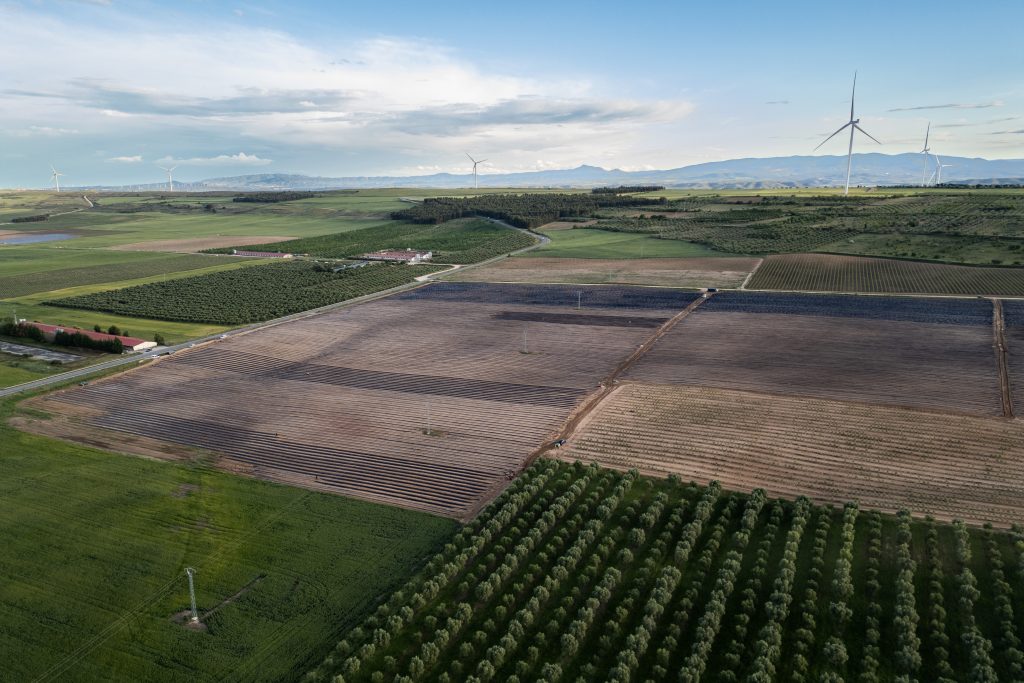
Over the past two years, agri-food companies have mobilised nearly €200 million in industrial investment in Navarra. Much of this activity is concentrated in La Ribera, where a powerful agro-industrial corridor is taking shape, supported by available industrial land, proximity to growing areas, logistical capacity and a long tradition of food industry manufacturing.
In this context, the Regional Minister for Industry and Ecological and Digital Business Transition, Mikel Irujo, believes that Navarra has succeeded in building a particularly competitive ecosystem for the development of new agro-industrial projects.
“Navarra has a highly specialised agri-food ecosystem, with companies capable of competing in international markets and a remarkable capacity to adapt to new technological, industrial and environmental challenges. The combination of industry, innovation, sustainability and public-private collaboration is enabling us to develop increasingly competitive business projects with ever greater added value”, he notes.
The Minister also highlights that the region possesses factors particularly valued by companies looking to grow or establish a presence in new territories: industrial capacity, export experience, access to specialist talent, technology centres and a broad network of institutional and financial support.
Indeed, much of Navarra’s appeal to new investors lies in the strength of an ecosystem that combines agricultural and livestock production, food processing industry, technology, logistics and specialist knowledge. The region has developed a highly integrated value chain where major corporate groups, cooperatives, industrial SMEs, food-tech start-ups and technology centres coexist — all capable of accelerating innovation and knowledge-transfer processes.
This environment explains why many companies are currently reinforcing their productive capacities in Navarra, and why international groups have chosen the region for new investment projects.
AN ECOSYSTEM IN FULL EXPANSION
One of the most representative examples of the sector’s current momentum is the project being driven by Congelados de Navarra in Arguedas. The company is carrying out a €59.5 million investment to expand productive capacity and strengthen its position in the frozen vegetable segment — one of the region’s major agro-industrial specialisations. The project is also expected to create around 110 new jobs.
This development also reflects the growing weight of the frozen food industry in Navarra. The region has built a highly competitive ecosystem in this field, thanks to its proximity to agricultural areas, accumulated industrial expertise and the presence of specialist cold-chain logistics operators.
The same logic underpins investments currently being driven by Gelagri and Lineage in Milagro. The French frozen vegetable specialist is committing close to €15 million, whilst the international logistics operator is expanding its facilities by more than 12,000 additional square metres as part of a joint operation valued at €17.1 million.
Lineage’s presence is particularly significant as it confirms the growing interest of major international operators in Navarra’s agro-industrial ecosystem. Regarded as one of the world’s leading cold-chain logistics groups, the company has made Navarre one of its strategic platforms for operations across southern Europe.
Industrial growth is also reaching other segments of the food sector. In Funes, for example, Elaborados Naturales de la Ribera recently completed a €40 million investment to expand its facilities and develop new production lines in prepared food and convenience products — one of the fastest-growing categories within the food industry. The project is also expected to create around 300 jobs.
The expansion of Navarra’s agri-food industry is also attracting fresh investment from multinational companies already established in the region. One example is the Peruvian multinational Virú, a specialist in asparagus and artichoke, which has decided to invest close to €20 million in Marcilla to expand productive capacity and boost exports to international markets.
Also, the Aceites Sandúa group has opened a new facility at the Ciudad Agroalimentaria de Tudela (CAT) with an investment of close to €10 million, reinforcing its international growth and the strategic alliance developed with Migasa through Oleosandúa. Meanwhile, Urzante announced an investment of €35 million that will allow it to increase its workforce by 80 people and expand its oil storage capacity with new steel tanks, whose total volume will rise from 40 to 60 million litres. The company currently employs 140 people.
Further projects include that of Intermalta in San Adrián, where the company will increase its productive capacity by 28.5%, as well as the investment by Monbake in Tajonar of close to €20 million, as part of the expansion undertaken following CVC Capital Partners’ acquisition of Berlys.
INTERNATIONAL CAPITAL AND BUSINESS CONSOLIDATION
The influx of new investment is coinciding with an intense process of business consolidation within Navarre’s agri-food sector. In recent years, several companies have been involved in corporate transactions that reflect both the industrial maturity of the ecosystem and the growing interest of international groups and specialist investment funds.
One of the most significant deals has been the acquisition of UVESA by the Ukrainian group MHP, backed by a public takeover bid that reached 91.77% of the share capital following approval by the Spanish Competition Authority (CNMC).
Other notable deals include the acquisition of the Dutch group Oerlemans Foods by Grupo Virto, a move that has strengthened its position in the European frozen vegetable market, and the acquisition of Berlys by CVC Capital Partners, which gave rise to the current Monbake group.
The influx of investment capital is not limited to large industrial operations. Navarra is also seeing the growth of an ecosystem linked to foodtech, biotechnology and food entrepreneurship that is beginning to attract specialist funds.
The influx of investment capital is not limited to large industrial operations. Navarra is also seeing growth in an ecosystem linked to foodtech, biotechnology and food entrepreneurship, which is beginning to attract specialist funds. Of particular note in this context is the activity of Stellum Food&Tech, a specialist vehicle of Stellum Capital endowed with €48 million, in which Sodena, the public company of the Government of Navarra, has committed €2.5 million. Through this vehicle, strategic transactions have been driven in Navarrese companies such as Envaplaster — where it acquired a 40% stake in 2022 — the biotechnology company Lev2050 — with the acquisition of a 25% stake alongside Inveready in 2024 — and Huerta de Peralta, in which it took a stake in 2026.
In addition, other similar funding sources exist, such as the Tech Transfer Agrifood, endowed with €14 million, in which Sodena has committed €300,000, with beneficiaries including Cocuus and MOA Foodtech.
FROM FOOD INDUSTRY TO BIOECONOMY
The transformation of Navarra’s agri-food industry cannot be explained by productive growth alone. A significant proportion of new business projects are also linked to sustainability, the circular economy, by-product valorisation and healthy food.
One of the most representative examples is the Circfood driven by Urzante, an initiative focused on the reutilisation of agri-food by-products that has already successfully reintroduced six by-products into the food value chain.
Applied food biotechnology is also gaining prominence within Navarra’s ecosystem. The start-up Lev2050, based in Aizoáin, works on the development of micro-organisms designed to optimise agri-food processes through biotechnology-based solutions.
Also, Real Green Food is carrying out an investment of close to €2.5 million in Lodosa linked to the sustainable production of sprouts and plant protein — one of the fastest-growing areas in the new food industry.
In parallel, companies such as Timac Agro, recognised with the Navarra Chamber of Commerce Innovation Award 2025, continues to develop next-generation fertilisers and strengthen its international presence in over 30 countries.
AN ECOSYSTEM OF TECHNOLOGY, KNOWLEDGE AND COLLABORATION
The strength of Navarra’s agri-food sector also rests on a powerful network of technological and institutional support.
Navarra is home to specialist organisations such as the CNTA (Centro Nacional de Tecnología y Seguridad Alimentaria), one of Europe’s leading reference centres for food innovation and food safety; INTIA, which specialises in agricultural technology transfer; and the cluster NAGRIFOOD, which brings together more than 80 companies and organisations across the entire agri-food chain.
This ecosystem facilitates the connection between industry, technology and knowledge, accelerating the development of new products, industrial processes and business models.
Complementing this is the role played by Sodena and Invest in Navarra, which work to facilitate the establishment and growth of new business projects through institutional support, financial assistance and connection with the region’s industrial and technological network.
The public company also participates in co-investment, financing and business support operations. Among recent actions, Sodena provided financing and guarantees worth €5 million to UVESA; and participated, alongside entrepreneur Santiago Sala, in a €350,000 investment in El Caserío de Tafalla aimed at strengthening the viability and continuity of this Navarrese company specialised in high-quality sweet manufacturing. At the same time, it joined the share capital of The Real Green Food (Gvtarra) to support the strengthening of its business model and its growth within the plant-based food and preserves segment.
“The combination of industry, innovation, sustainability and public-private collaboration is enabling us to develop increasingly competitive business projects with ever greater added value“


MIKEL IRUJO
Regional Minister of Industry and Ecological and Digital Business Transition
La Ribera concentrates much of the new agro-industrial investment
The concentration of investment in recent years has turned La Ribera in Navarra into one of the leading agro-industrial hubs in northern Spain.
Municipalities such as Arguedas, Milagro, Marcilla, San Adrián, Peralta and Tudela currently host projects linked to frozen vegetables, food logistics, prepared food, oils and food ingredients.
The availability of industrial land, proximity to growing areas and the existence of specialist infrastructure have fostered the emergence of a powerful agro-industrial corridor capable of attracting both domestic investment and international groups.
Facilities such as the Ciudad Agroalimentaria de Tudela (CAT) have also become one of the sector’s leading activity hubs, thanks to the concentration of companies, services and infrastructure linked to food production and processing.
Innovation, industrial cold chain and sustainability will define the sector’s future
Navarra’s agri-food sector is rapidly evolving towards increasingly technology-intensive, automated and innovative models.
The incorporation of artificial intelligence, data analytics, industrial automation and biotechnological solutions is enabling the development of more efficient, sustainable processes better adapted to new consumer demands.
This is complemented by growth in areas such as foodtech, plant protein, by-product valorisation and the bioeconomy — segments in which Navarra is beginning to consolidate a specialist ecosystem supported by start-ups, technology centres and investment funds.
This transformation reflects how Navarra has moved from historically building its agri-food leadership on vegetable preserves and agricultural processing to developing a far more diversified, technology-driven and internationally oriented agri-food industry.