



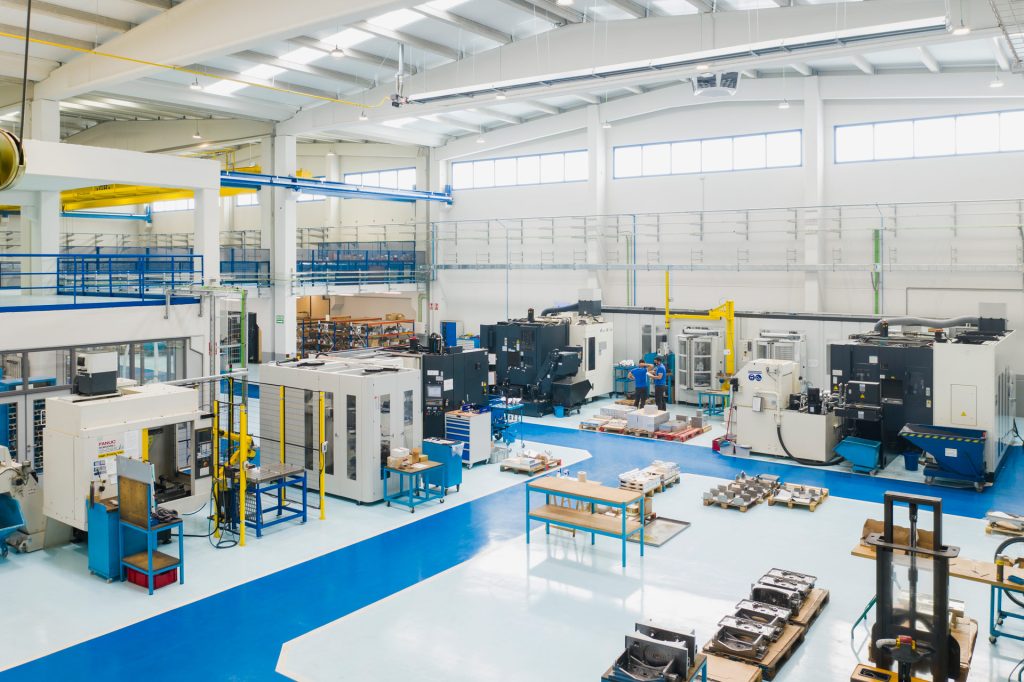
- The Regional Community already has an ecosystem that combines leading companies, technological SMEs, knowledge centers, and industrial capabilities from fields such as automotive, energy, advanced mechatronics, and electronics
Navarra’s aerospace sector already generates more than €300 million in revenue and employs nearly 1,000 people, a figure that confirms how rapidly it has scaled its economic weight and importance in just a few years
This development aligns with the new phase of the Smart Specialisation Strategy S4, in which aerospace appears alongside other emerging niches as an activity with the potential to grow in size, technological sophistication, and international reach
Navarra’s aerospace sector is currently undergoing a phase of consolidation and growth that positions it as one of the new vectors of industrial diversification in the region. In just a few years, this ecosystem has evolved from a small group of technology companies into an increasingly broad network integrating industrial firms, specialized engineering companies, technology centers, and universities.
In this sense, Navarra’s aerospace industry already generates more than €300 million in revenue and nearly 1,000 jobs, figures that reflect how quickly it has gained weight within the regional productive fabric. In view of these data and the evolution recorded in recent years, the Government of Navarra considers that this growth confirms the potential of a knowledge- and technology-intensive industry that is set to play an increasingly relevant role in the territory’s economic future.
This was expressed by the Minister of Industry and Ecological and Digital Business Transition, Mikel Irujo, who recently stressed that Navarra has an industrial and technological base that is particularly favorable for the development of this activity. To this end, the regional government has set the next objective of strengthening public support for the sector. “We want to provide aerospace companies established in the region with programs and initiatives that foster their own aerospace R&D&I, public financing for specific projects, as well as the promotion of public-private collaboration in areas that enhance sector competitiveness,” he explained.
All these measures share the common purpose of facilitating knowledge transfer between different productive sectors, as this exchange is considered key for the sector to increase its potential. In this scenario, Navarra starts from a very strong position, as its significant industrial base includes companies that have developed advanced capabilities in areas such as automotive, industrial automation, electronics, and process engineering, and are now adapting these technologies to the demanding standards of the aerospace industry.
On the other hand, another opportunity in the region lies in collaboration. In this area, the public company Sodena plays a fundamental role as a support agent, especially in ensuring the successful establishment and growth of new business initiatives. “Any aerospace company that decides to set up in Navarra can benefit from our support in connecting with the local industrial and technological ecosystem, finding the most suitable location for their business idea, navigating administrative processes, and accessing financial instruments such as loans, guarantees, etc.,” said Juan Cristóbal García, Director of the Regional Strategy Area at the public company.
A ROBUST ECOSYSTEM
The strength of Navarra’s aerospace ecosystem is also explained by the presence of specialized technology centers capable of transferring innovation into concrete industrial applications. NAITEC, for example, highlights the importance of combining talent, technology, and industrial vision to transform research into real solutions for the sector. “In recent years, we have worked in strategic areas such as new materials, advanced surfaces, and innovative manufacturing processes that make it possible to create lighter, more functional, and more efficient components,” explained its Market and Strategy Director, Kike Mendoza.
They have also focused on developing solutions based on intelligent data, as well as validation processes. “In this field, we carry out various tests and trials, such as structural or mechanical testing, with the aim of ensuring that components meet the demanding standards of the aerospace sector,” he confirmed.
Finally, the aerospace industry is seen as a key element in the region’s territorial cohesion, with a significant hub around the Estella area that aims to become one of the main development poles of the sector. The President of the Association of Companies of the Estella District (Laseme), Carlos Ros, summarized it as follows: “We want Estella to become the pilot territory for initiatives that may emerge in this sector, and that is why at Laseme we make all our capabilities available to interested companies.”
“The metalworking sector in Navarra offers enormous potential in areas requiring high precision and added value – key factors essential to the aerospace industry”


PEDRO DUQUE
Astronaut
SUCCESS STORIES
The development of the aerospace sector in Navarra is supported by an increasingly broad business ecosystem that combines established industrial companies, technology engineering firms, knowledge centers, and specialized startups.
Among the companies already participating in aerospace projects are firms such as MTorres, an international benchmark in industrial automation and a regular partner in Airbus’ supply chain, as well as other companies linked to drones, electronic systems, advanced engineering, and sensing technologies.
Within this ecosystem are companies such as Tracasa, Anteral, Orbital Critical Systems, Grupo EOSOL, Microlan, Delmon, Falcón, and Piher, among others, in addition to technology centers and universities that help strengthen the sector’s innovation capabilities.
Two examples clearly illustrate the level of internationalization already achieved by some Navarrese companies. One is Microlan Aerospace, a company specialized in advanced electronics that has been linked to the aerospace sector for more than two decades. Its CEO, Javier Etxeberría, recalls that when the company began its journey in this field, it was practically a strategic bet. Today, however, the company participates in large-scale international projects. Among them, it worked on an electric air taxi project linked to advanced air mobility known as LILIUM. More recently, it has taken part in the AST SpaceMobile program, a constellation of low Earth orbit satellites that will enable global mobile coverage from space.
Another “notable case” is represented by Orbital Critical Systems, a company within the CAF Group specialized in the development of safety-critical systems. The company works on the design and development of systems that must operate with the highest levels of reliability and collaborates with international companies such as Airbus, Indra, Thales Alenia Space, Mercury Systems, and TMB Aerospace. In addition, it provides engineering services throughout the entire product lifecycle, including design, validation, certification, and technical consulting.
‘We want to provide programmes and initiatives to our own aerospace companies in Navarra that will enable them for developing an aerospace R&D made in Navarra"

MIKEL IRUJO
Regional Minister of Industry and Ecological and Digital Business Transition
The roadmap to boost Navarra’s aerospace sector
With the aim of consolidating this emerging ecosystem, the Government of Navarra has defined a specific roadmap to promote the development of the aerospace sector in the coming years.
The plan includes 12 concrete measures aimed at strengthening business growth, technological innovation, and the international projection of Navarrese companies:
– Establish a stable space for collaboration between companies and the Administration to facilitate knowledge exchange and define common objectives.
– Develop a sectoral strategic plan by establishing an aerospace industry roundtable to promote growth in the number of companies, their size and their strategic partnerships.
– Prepare a new sector report in 2026 to define lines of work and budgets for 2027, with the aim of launching a program to boost SME investment and competitiveness endowed with €15 million annually.
– Maintain continued support for R&D&I, integrating the aerospace sector into collaborative and strategic project lines endowed with €35 million annually in collaboration with NAITEC.
– Promote technological entrepreneurship, specialized training, and talent attraction through the public company CEIN.
– Activate specific financing lines through Sodena, including funding channels of up to €40 million through the Arraigo Funds.
– Increase the sector’s visibility at local and international level to facilitate its connection with other industries with complementary capabilities.
– Create a one-stop business service, managed by Sodena, to facilitate companies’ interaction with the Administration.
– Analyze, together with the sector, the training and professional qualification needs required for its development.
– Promote access to international markets through diagnostic actions, commercial acceleration, strategic mentoring, or participation in trade fairs within the Navarra International Plan.
– Align the sector’s development with national and European programs linked to the aerospace industry.
– Support SMEs in obtaining sector-specific certifications, such as the EN 9100 standard, required to operate in international supply chains.