



- The region has an industrial, technological and energy ecosystem centred on green hydrogen, making it one of the most attractive areas in southern Europe for the development of projects linked to this key vector for industrial decarbonisation.
- The combination of renewable capacity, industrial fabric, planned infrastructure, technological innovation and a differential tax framework reinforces the appeal of the region in the face of growing interest from international investors.
Green hydrogen is not a future prospect in Navarra, but a reality currently being rolled out, with industrial projects already operational, production plants under development and a clear roadmap towards connection with the major European clean energy corridors.
The green hydrogen ecosystem in Navarra has developed progressively and solidly in recent years, based on three fundamental pillars: technology, industry and public policy.
The region has internationally renowned technology centres, such as CENER, NAITEC and AIN, which lead applied research projects, technological validation and industrial demonstrations. Added to this is an industrial fabric that produces and consumes hydrogen, with leading companies and highly specialised SMEs, and an aligned institutional environment that promotes strategies, infrastructure and public-private collaboration to accelerate its implementation.
It should also be noted that Sodena has positioned itself as a key player in this scenario, promoting strategic investments such as its stake in Nordex Electrolyzers to manufacture electrolysers locally and support decarbonisation. Or, where appropriate, acting as a financial partner and facilitator of pioneering projects, and actively participating in the consolidation of the sector through the Green Hydrogen Roundtable, consolidating Navarre as a benchmark in clean energy.
Furthermore, the region has distinctive competitive advantages that make it a strategic location for renewable hydrogen projects. Its industrial capacity, consolidated over decades of commitment to renewable energies, has made it a pioneer in Europe.
With more than 110 companies specialising in energy technologies, around 6,400 direct jobs and accounting for nearly 5 % of regional GDP, Navarra has a high concentration of technological talent, advanced engineering and capital goods manufacturing. This industrial base allows it to address the entire hydrogen value chain, from the design and manufacture of components to their integration into industrial processes.
STRATEGIC INFRASTRUCTURE AND LOCATION
One of the main attractions for investors is the planning of large-scale energy infrastructure. Navarra will form part of the Green Hydrogen Backbone Network, promoted by Enagás as a Project of Common European Interest.
In the first phase, scheduled to run until 2030, 37 kilometres of transport network will be deployed in the south of the region. In the second phase, scheduled for completion in 2040, the route will exceed 150 kilometres, crossing Navarre from north to south and connecting with France via Larrau, which will enable the export of renewable hydrogen to the European market. This infrastructure therefore reinforces the viability of large-scale production projects and positions this territory as a strategic hub within the European hydrogen corridor.
INNOVATION AND TAXATION
In addition to all of the above, applied innovation is one of the pillars of Navarra’s green hydrogen ecosystem. Centres such as AIN combine direct support for industry with the development of pilot facilities and demonstration projects. An example of the latter is the CARMA H2 project, which analyses the production of hydrogen from biogas through electrolysis, one of the first projects of its kind in Europe. Thanks to initiatives of this type, the region is at the forefront of advanced experimentation and technology transfer.
There is also a highly competitive fiscal framework for projects related to green hydrogen. Among the main incentives are:
- Deductions of up to 30 % for investments in renewable hydrogen consumption to replace natural gas.
- Deductions of 15 % for investments in hydrogen production and the manufacture of components in its value chain, with a maximum of €15 million per company and project.
This set of incentives makes Navarra a particularly attractive location for the establishment of factories, production plants and associated infrastructure.
GOVERNANCE AND PUBLIC-PRIVATE PARTNERSHIPS
Finally, the Navarra Hydrogen Board, made up of 45 companies and 15 institutions, acts as a forum for coordination, dialogue and anticipation. Its work focuses on providing information, promoting collaborative projects and supporting industry in its decarbonisation and energy supply strategies.
In short, the region currently brings together real projects underway, planned infrastructure, industrial capacity, technological innovation and a differential tax framework, providing it with a green hydrogen ecosystem that not only is committed to the future of energy, but is already generating industrial activity, knowledge and economic opportunities.
"Green hydrogen will not only become a source for decarbonising our industry, but will also bring value to our community."


MIKEL IRUJO
Regional Minister for Industry and Ecological and Digital Business Transition
Industrial projects: The ‘crown jewels’ of the Green Hydrogen Ecosystem in Navarra
1. Statkraft & Enhol Group green hydrogen plant (Tudela)
The green hydrogen plant in the Tudela Agri-Food City (CAT) is one of the most advanced and emblematic projects in the hydrogen ecosystem in Navarre. Promoted by the Norwegian multinational Statkraft, which specialises in renewable energy, and the Navarran energy group Enhol, this project involves the construction of a 5 MW electrolysis facility on a plot of more than 18,500 m² within the CAT. The plant will produce up to 742 tonnes of green hydrogen per year using exclusively energy from renewable sources, mainly wind and solar, making it an example of sustainable production integrated into an industrial estate with high energy demand.
The agreement includes a 20-year lease-purchase agreement and an estimated investment of over €8 million, combining private contributions, public investment and European funds. Construction is scheduled to begin in the second half of 2026, with operations commencing in 2027, and the project is expected to play a key role in supplying hydrogen to industrial companies and local cogeneration services, significantly reducing their carbon footprint.
2. Electrolysers from Nordex Electrolyzers (Lumbier)
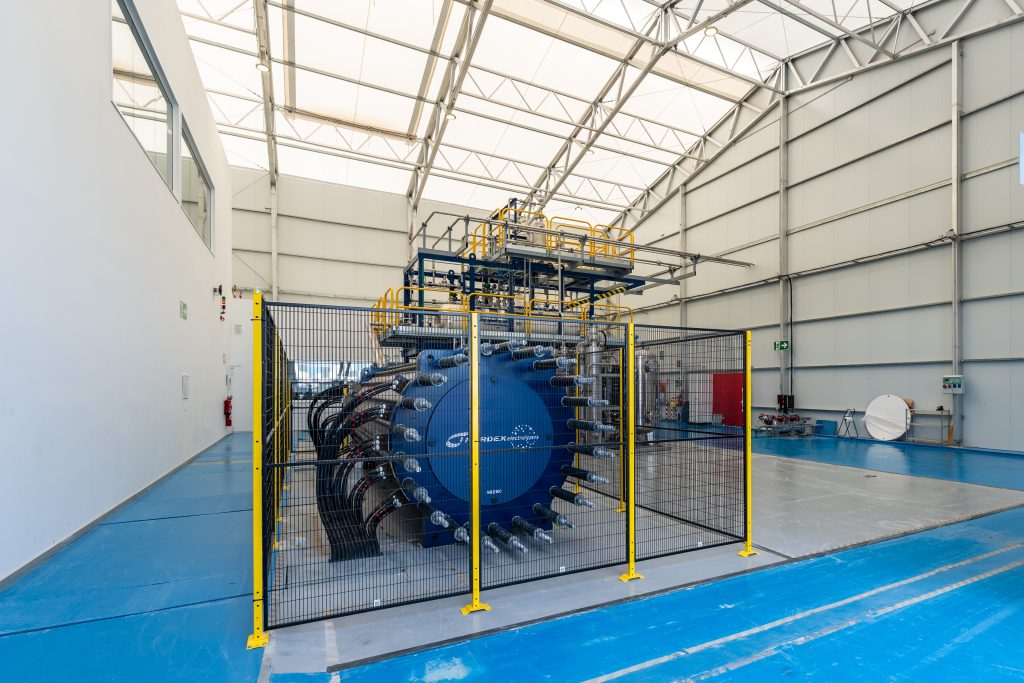
The development of modular electrolysers by Nordex Electrolyzers (a company in which Sodena acts as a co-investor) represents a key technological advance for the hydrogen ecosystem in Navarre. Nordex, with a long history in renewable energy solutions, has designed and begun manufacturing prototypes of 500 kW electrolysers in Navarre, with the capacity to group them together for configurations of 5 MW and even 10 MW in later phases. This modular technology is essential for driving electrolysis on an industrial scale and positions the region as a major centre for engineering and manufacturing components for green hydrogen production.
The project is part of industrial innovation initiatives partially funded by public and European programmes such as MITECO’s RENOVAL programme, which in 2025 allocated significant resources to Navarre for advanced renewable technologies. The prototypes have been successfully integrated into real industrial facilities, as part of the consortium operating at Viscofan in Cáseda, demonstrating technical capability and operational reliability. From 2026 onwards, it is expected that a mass production line will be consolidated in Navarra, reinforcing its appeal to companies and technology centres interested in hydrogen electrolysis solutions.
3. H2OP Project at Viscofan (Cáseda)
The H2OP project, led by global manufacturer Viscofan together with Nordex Electrolyzers, AIN and URAPHEX, is one of the first operational industrial green hydrogen demonstrators in Navarre. The consortium has successfully installed a 500 kW electrolyser at Viscofan’s facilities in Cáseda, integrated into its production process to replace fossil fuels in steam generation. This real-world integration has validated the technical feasibility of renewable hydrogen as an energy substitute in intensive industrial processes, reducing CO₂ emissions and improving the operational sustainability of a traditional industrial plant.
The H2OP project combines complementary industrial and technological capabilities: Viscofan provides the industrial infrastructure and energy needs, Nordex and URAPHEX provide the equipment and technological solutions, and AIN provides technical coordination and knowledge transfer. This demonstrator not only highlights Navarra’s capacity to develop cutting-edge energy solutions, but also serves as a replicable case for other European industries interested in decarbonising their processes with green hydrogen.
4. Valle H2V Navarra Project by ACCIONA Energía & Plug Power (Sangüesa)
The Valle H2V Navarra project, jointly promoted by ACCIONA Energía and the American company Plug Power through the company ACCIONAPLUG, represents one of the most ambitious green hydrogen initiatives in Europe. Located in Rocaforte (Sangüesa), it is designed to build a green hydrogen production plant with 25 MW of industrial electrolysis capacity, integrating hybrid energy from a 25 MW photovoltaic park and a 24 MW wind farm, both under development in the same area. The plant will produce around 3,880 tonnes of green hydrogen per year, with around 90 % of its production going to energy-intensive industries in the region — such as paper, glass, steel, food and automotive — contributing to their decarbonisation.
The project, declared of regional interest by the Government of Navarre, involves a total investment of €87 million and is expected to generate more than 500 direct, indirect and induced jobs during its construction phase. It also includes the installation of a hydrogen refuelling station on site for use in mobility, which diversifies its economic and energy impact. The project design allows for future expansion to 50 MW of capacity depending on the evolution of demand for green hydrogen. This initiative puts Navarre on the European map as a benchmark for large-scale production and scalability of renewable hydrogen.
“Navarre has cutting-edge technology in the field of green hydrogen, developed locally to meet current and future demand in the European market.”